

Table of Contents
- 12 Indoor Dog Activities in Spring
- 1. Indoor Dog Tug-of-War Game
- 2. Hide-and-Seek At Home
- 3. Indoor Agility Course
- 4. Indoor Fetch
- 5. Fun Puzzle Toys
- 6. Spring Doggy Play Date Activity At Home
- Observe But Let Them Play
- 7. Indoor Spring Bath
- 8. Shell Game for Dogs at Home
- 9. Clicker Training
- 10. Make Dogs Do Indoor Spring Chores
- 11. Mastering Obedience Training
- 12. Dog Massage in Spring
- Frequently Asked Questions
- Indoor Dog Activities in Spring: Before You Go…
Spring elements like allergies, fevers, and dangers can bar your excited Fidos from going outside.
If your dog’s going to be stuck inside, then maybe some indoor dog activities in spring can shake your dog’s boredom away.
In this blog, we’ve listed twelve spring activities for dogs at home.
We compiled this list because we don’t want the indoor setup to hinder your dog from enjoying spring.
These things to do with your dog at home are guaranteed to bring fun to them during spring!
12 Indoor Dog Activities in Spring
 1. Indoor Dog Tug-of-War Game
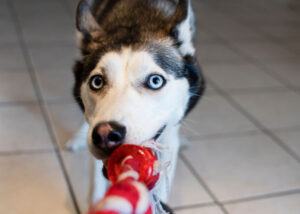
Tug-of-war is a great physical exercise that can get the dog moving, even in the comforts of your own home.
It is also a great mental exercise because it stimulates their instincts when they bite.
Picking the Toy
The right toy rope is the difference between good and bad tug-of-war play.
A large rope is longer and has larger knots. The size may be stimulating for larger dogs, but small dogs might not be able to bite or hold onto it.
Some ropes also have an appropriate length of space between your hand and your dog’s bite grip.
The dog toy ropes that we recommend for tug-of-war play with your dog are:
How to Play Tug
Depending on your dog’s temperament, your dog may or may not instantly understand and get the activity. But in most cases, your pet needs to learn the game first.
To play tug-of-war with your dog, you should introduce the rope object first to it.
Reward your dog when it’s interacting with the object, and then specify by giving rewards only when it’s mouthing the rope.
Continue training your dog to perform the tugging action.
Let your pet hold the rope with its mouth, tug the rope, and reward it when it’s tugging the rope as well.
Lastly, a release command is important to halt the activity.
Verbal cues are important, like “drop it” or “drop,” to have a firm command of the dog.
It would also be helpful if you reward your dog with treats when it successfully and intentionally releases its bite.
Accidental Bites
Your pet may growl as they bite and hold the toy rope. This is normal as the growl comes with their predator instinct when they bite.
That being said, your dog may take the activity and growling too far. They may even get overly competitive with you.
Even worse, your dog can accidentally bite you during the session.
When this happens, immediately stop the play, drop the toy, and do the activity next time.
RELATED: How to Treat a Dog Bite Wound

2. Hide-and-Seek At Home
Hide-and-seek is one of the playful spring activities for dogs at home.
This game can be mentally stimulating for the dog because finding their owners is challenging.
Hide-and-seek becomes much more stimulating if your dog has a keen sense of smell or has mastered nose work.
How to Play Indoor Hide and Seek with Dogs
Teaching hide-and-seek with your dog should be gradual, with steps.
You can start training by making your dog sit and stay as you walk away from them. If the dog controls its urge to follow you, you're making progress.
From there, you can call your dog out from your hiding spot and finally let the dog approach you.
You can also add verbal cues to help them become accustomed to a specific command.
Make the preparation gradual when preparing the dog for the activity.
Most importantly, don't forget to use rewards, positive reinforcements, and treats throughout the training.
RELATED: This Device Creates a Hide-And-Seek Game With Dog Treats
Destructive Behaviors
In some instances of the game, your dog may cause a ruckus in the process of finding you. They may break things or damage appliances in your house.
When this happens, you probably didn’t introduce the game to your dog gradually.
Let your dog find you in easy spots first, sometimes partially revealing yourself to your pet. Any slight handicap builds a pattern of where to look when you hide.
If their destructive behavior persists, take a break, don’t reward them, and halt the game immediately.
Instead, you think of other things to do with dogs at home.

3. Indoor Agility Course
Is your dog sporty? Is it built for athletic and must-trained activities?
If your answer is yes, then agility course training is a much better activity for them!
An agility course is one of the spring activities for dogs at home that takes advantage of your dog’s power, speed, and stamina.
This sport also highlights their ability to listen to commands.
Agility courses are typically set outside where there’s enough space between pieces of equipment.
But since it's also one of the fun things to do with your dog at home, you can build it inside, too!
Indoor Obstacle Course Products
There are many readily available obstacle course products on the market.
You can take advantage of their availability to conveniently enroll your dogs in a course.
Some obstacle course products that we recommend to you are:
Alternatively, if you don’t want to spend on these products, you can also improvise using materials you may find in your house.

4. Indoor Fetch
Fetch is one of many spring dog activities at home that you can do with your pet dogs.
And that’s right! You can do fetching indoors, too!
Just take note that you may not be able to throw the object indoors at a longer distance than when you throw it outside.
Picking the Right Fetch Toy
The right fetch toy matters whenever you play dog to fetch.
Your fetch toy should be flexible, durable, and easy to clean. It should also fit in the dog’s mouth; if it's too large, the dog will be discouraged from holding the object.
We also have some dog fetch toy recommendations that you may want to check out.
How to Teach Fetch to Dogs at Home
For dogs just starting to play fetch, first encourage them to interact with the toy itself.
Interaction with the fetch toy signifies to your dog that the object will be a key focus in this activity. Let your dog investigate and familiarize the toy.
Once they become acquainted with the object, you can start teaching your dog to hold it.
To teach hold, restrict giving the reward only when the dog bites and hold on to the object.
After building consistent results with the training, teach them to release and return the object to you.
You can also introduce verbal cues like “give” while extending your arms. This lets the dog know where to drop the object and where to place it in their mouth.
Now that they know how to hold and release at your command, you can teach fetch to your dog.
Instead of holding the toy, you can place it on the ground and command the dog to get it.
From there, build the training by adding distance, distractions, new objects, and the “fetch” cue.
RELATED: How To Train A Dog To Fetch: An Easy-To-Follow Video Guide
5. Fun Puzzle Toys
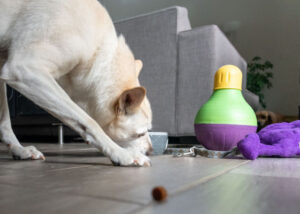
Another set of objects that you may want to invest in for your dog is a puzzle toy.
Puzzle toys really know how to keep dogs entertained, thanks to their mental stimulation.
These puzzles can also help calm the dogs whenever they feel anxious or agitated.
Some of the products that we used and reviewed are as follows:
6. Spring Doggy Play Date Activity At Home
As the name suggests, a dog playdate is an activity where your pet plays with another dog.
Play dates are important because they fill your dog’s need to socialize with other dogs.
Usually, a dog playdate should be held outside, where there is enough space for them to roam.
But in cases of extreme spring weather, indoor dog activities can be used instead.
Here are the steps to plan a fun playdate for your dog.
Know Your Dog's Personality
A dog's personality and temperament are major factors when planning a dog playdate.
Before proceeding to set the date, ask yourself.
Is your dog friendly to strangers? Do they bark agitatedly when they see new faces and pooches?
Is your dog fine by itself? Or does it constantly crave the attention and accompaniment of others?
And what about its dominance? Does your dog exhibit strong territorial and protective behaviors?
These are the questions that you need to ask yourself to probe into your dog’s personality and traits.
 Match to a Dog with the Same Playstyle
If you’re sure that you have a grasp of your dog’s personality, you can proceed with matching your dog to its date.
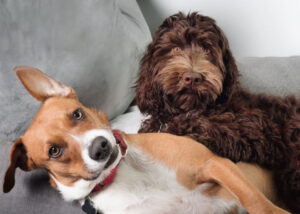
The dog date should have a similar personality, temperament, playstyle, and even size to your dog.
There should be chemistry or compatibility between the dogs for them to have meaningful and engaging playtime.
Otherwise, the supposed fun playdate could turn into something aggressive, maybe even harmful.
RELATED: How Do You Check a Dog’s Temperament?
Preparing for the Indoor Playdate
It’s uncommon for playdates to happen at one of the dog owners' houses.
We don’t typically recommend indoor playdates as a spring activity for dogs at home.
Instead, we recommend choosing neutral locations for the playdate to reduce the risk of dog aggression.
Neutral locations can be indoor dog daycares or indoor dog parks, to name a few.
That being said, there are a few exceptions to this.
If both dogs have easy and outgoing personalities, you can do the date in one of the dog owners' houses.
Make sure there's a large space in the house where your dogs can play together.
Observe But Let Them Play
Don’t force the dogs to interact with each other. Otherwise, you’ll be stressing the dogs by putting them in an uncomfortable situation.
Instead, do the introductions based on the dogs’ pace. Let the dogs take their time sniffing at each other.
Only interfere with the dog’s activity when you notice aggression in your dog’s behavior.

7. Indoor Spring Bath
Bath time becomes a natural indoor spring activity. Your dog will naturally shed their winter coat as spring approaches.
Because of that, bath time during spring is your chance to clean your dogs from debris and dirt.
The touch of water and soap is refreshing for your dogs, especially as warm days start.
Below are some tips for bathing your dog in springtime.
Choosing the Right Products
Many owners think all shampoos are the same. But in reality, the right shampoo matters in providing pristine dog care for your pet.
For instance, owners think human shampoos can be used on dogs. But the thing about human shampoos is that they are too acidic for any dog’s hair.
Thus, human shampoo on dogs dries out their skin and makes the coat brittle. Human shampoos are definitely a no-go for dogs.
When looking for a dog shampoo product you can trust, check whether the formulation contains allergy-triggering chemicals.
Some of the chemicals to look out for are:
- 1-Bromo-2-nitropropane-1, 3-diol
- Glyceryl stearate
- Lanolin
- Methylchloroisothiasolinone & methylisothiasolinone
- Cocamide DEA
- Cocamide MEA
- Cocamide MIPA
- Propylene glycol
- Isopropanolamine
- Limonene
- Petrolatum
- Stearyl alcohol
You should also avoid dog shampoos containing parabens, as they can cause serious health issues in dogs.
Here are some dog shampoo products that we recommend:
- Earthbath Hypoallergenic Dog Shampoo
- Earthbath Deodorizing Dog Shampoo
- WAHL Pet Shampoo for Dogs
- Pro Pet Works Dog Shampoo
- 4Legger Organic Dog Shampoo
Giving Your Dog a Bath
Here are the steps to give your dog a refreshing bath in spring
- Brush your pet’s fur coat to drop loose hairs, debris, and dead skins
- Wet your dog’s fur and apply a reasonable amount of shampoo to its coat
- Massage its coat and leave it for a few minutes
- Rinse the foam after letting the shampoo sit in the dog’s fur
- Make sure that there’s no residual shampoo on its fur
- Blot every wet spot of the dog using a dry towel.
Giving your dogs a bath is relatively easy because it’s similar to taking a bath.
The real problem in bathing, however, is the dog’s unwillingness to take a bath.
Some dogs are like reluctant kids who hate the idea of bath time.
Make the bath session more enjoyable for your dog by sprinkling rewards throughout.
Give it rewards through treats as it gets into the tub, during bath time, and after it leaves the tub.
RELATED: How To Give A Dog A Bath
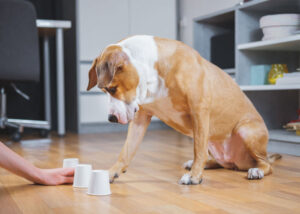 8. Shell Game for Dogs at Home
Shell games are great indoor dog activities in spring. This game can help provide stimulation, as your dog will be highly sensitive to it during spring.
The best thing about shell games is that they're easy to play with your dog, provided you've taught them the game. It’s also a way to make your dog work for its food or treat.
To play the shell game with your dog:
- Get two to three cups, bowls, or shells
- Show a treat to your dog before placing it in the shell
- Move the cups around and let the dog follow the shell with the treat
- After moving the cups around, stop to let the dog guess the shell with the treat
- Your dog should use their paw or nose to inform you about their guess
- Lift the chosen cup to reveal its inside
- If the treat is in the cup, immediately give the dog its reward
- If the dog treat isn’t there, close the cup, lift the cup that contains the treat, and restart the game
Before the actual game, you need to thoroughly teach the game to your dog.
Training, such as impulse control and even pawing to communicate, is necessary before you start the game.
To make the game more interesting, you can add more cups, move them more quickly, or use a treat with a milder odor.
RELATED: 7 Best Games to Play With Dogs

9. Clicker Training
Clicker training is one of many indoor dog activities in spring. It’s your means of practicing and preparing your dog before taking them outside.
Clicker training is one of the fundamentals in dog training that marks desirable behavior and action.
Basically, you are using treats and clicks to tell them what they should do in the future.
But clicker training would mean nothing to your dog if you haven’t “loaded the clicker” yet.
They first need to know that treats would immediately follow a particular cue.
As such, here are the steps to load the clicker:
- Choose a click like a clicker device, whistle, or tongue clicks
- Take your dog to a distraction-free environment. Doing clicker training indoors removes outside distractions
- Click your cue and immediately follow it up with a treat
- Repeat the clicking step 10 to 30 times.

10. Make Dogs Do Indoor Spring Chores
Household chores are tedious, especially during spring.
After all, there’s a lot of dusting, laundry, and taking out trash that you need to do once the snow melts.
Chores are dreary indoor activities that most people avoid. But not for dogs.
For them, performing a task when instructed is a way to stimulate their minds.
And if you give them treats after doing a task, they’ll think that chores are enjoyable activities indoors.
Teaching chores to dogs follows a similar process to teaching those tricks and games.
You just need to take it gradually and be patient with each step. Positive reinforcement also helps mark the action you want them to do.
Some of the household chores that you can teach them are:
- Fetching newspapers
- Closing doors
- Waking up family members
- Bringing items

11. Mastering Obedience Training
Show your dog who’s the boss inside your house with obedience training.
Obedience or respect training is a great indoor dog activity in spring that helps set boundaries between you and your dog.
A lot of the respect training depends on how firm you are with your commands.
That's why you should be calm yet assertive in your instructions. If you instruct commands with a jumpy tone, your dog won’t see you as a dominant figure.
Additionally, here are some ways you can subtly demand respect from your dominant canine friend:
- Make them earn the reward
- Not letting your dog pull its leash and lead the way
- Making your dog do simple commands
- Using corrective verbal cues like “no.”
- Letting your dog ask for affection instead
RELATED: Disobedience In Dogs: Ways To Control A Disobedient Dog

12. Dog Massage in Spring
Dog massage is one of the rarest home springtime dog activities. But giving your dogs a massage can bring many benefits.
Gentle massages for your dog can help reduce mental stress, anxiety, and confusion as spring arrives.
It also promotes blood circulation, which is good for dogs that become stagnant during winter.
Apart from that, dog massages are great as a pre-workout and post-workout routine.
Massages can serve as a warm-up for your dogs before an intense activity. It also helps relieve muscle soreness, cramps, and joint stiffening after the activity.
RELATED: TOP #41: Benefits of Dog Massage and How to Treat Your Pets at Home
Frequently Asked Questions
Indoor Dog Activities in Spring: Before You Go…
Any springtime dog activities at home can be a great source of physical and mental stimulation for your pet.
With enough preparation, you can make indoor dog activities in spring as fun as outdoor recreation!
We hope this article gave you some ideas to apply to your dog’s activities this spring.
But if you and your dog have the chance to go out during spring without compromising safety, why wouldn’t you?
Want to learn more about dog care in spring? Check out our recommended articles below!