

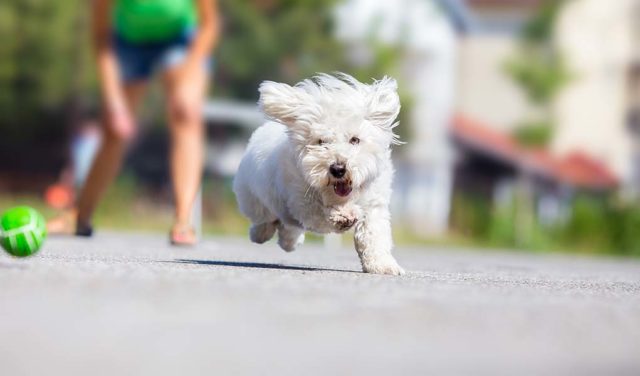
Having a dog also means having the best trainer you could possibly ask for. Most healthy dogs are incredibly energetic creatures, some active breeds more enthusiastic than others, who like nothing more than to play with their owners, especially if that includes runs and workouts. Training with your pet is an excellent way to bond with your dog through a useful exercise that benefits both of you.
Your pup can also be a great motivator because, unlike you, canines rarely lack any enthusiasm, and their over-excitement can be just the thing you need to jump out of bed and put your sneakers on. Even more so if you have a hyperactive dog.
Make sure you don’t pressure your pooch into training with you in winter if the breed isn't suited to that weather and low temperatures. The same applies for hot weather and workouts in scorching sun. Dogs may be up for it, but there are likely health consequences.
If you plan more serious workouts with your pup, always consult both your doctor and your vet to make sure you're both up for it. Some breeds are genetically predisposed towards workouts, but it is always better to double-check. You can also use a dog fitness tracker to monitor your pet's activity levels and overall health during workouts.
Before moving on to serious workouts, keep a few things in mind.
ALSO READ: 10 Best Dogs to Run With and Breeds That LOVE Running
5 Things Before Working Out with Dogs
Start Slowly, and Bring Your Dog Into Shape
 Just as people need an adapting period before they can consistently run for miles, so do dogs. If you're preparing for challenging jogs, start with shorter distances to teach him the basics that matter for longer runs later on.
Show your pet he is an active participant in the workout, but don’t pull him out of his comfort zone by dragging him or forcing him to run. The dog should quickly develop his own rhythm, and you should do your best to respect it and work around it.
Prevent Excessive Sniffing
Dogs instinctively sniff everything along the running path to mark the space and learn the way back. However, when you go for a run, the primary activity should be running, so try to discourage excessive sniffing. It divides his attention, and you need to prevent it if you want your dog focused.
To do this, give your pooch a few minutes alone with the route you plan to use so he can sniff around and check all points of interest. Once he gets to know the path better, he will be more relaxed and willing to run without interruptions, making it a routine.
Know Your Dog
It is always a good idea to know the specifics of the breed, as they can vary significantly from one another. Some are made for long runs or more strenuous workouts, while others will develop health problems from the same workload.
Brachycephalic breeds like Pugs and French Bulldogs have a flat snout and find it harder to work out, while some larger breeds like Dobermans and German Shepherds are more prone to canine bloat. It is a potentially fatal condition that can occur if a dog starts exercising on a full stomach.
To avoid damaging pets' joints and muscles, large breeds of dogs must have limited physical activity until they reach maturity, which is between 18 and 24 months.

Always Use Positive Reinforcement
Whenever you want your canine to learn something, whether it's going for a run or learning to sit on command, always pet him and reward him with treats for positive behavior. Shouting and forcing your dog to do anything will not accomplish your goals.
The same applies to running with dogs. Use positive reinforcement after every successful run at first, because it’s vital that your dog realizes he did something good so he'll do it again.
Use a Short Leash, and Do Some Off-leash Training
Dogs can be unpredictable, especially with new activities. Unless you keep him on a leash while running, he can cause trouble when exploring new routes or trying new things before you have a chance to stop him.
Yanking the leash too strongly or too often while running or exercising will hurt your dog too. The best approach is to train your dog to walk on a leash, then move to off-leash training, and use a short leash when you have to.
15 Fun Ways to Work Out With Your Dog

1. Run as One
There is an alternative to keeping your pooch on a leash that can be more interesting for both you and your dog. If you want to avoid holding the leash all the time while running, consider a hands-free dog leash you can safely attach to your waist.
You should also look into “Running with Dogs” organizations, which are a great example of how hands-free leashes are used, such as CaniX. CaniX started as a way to keep Huskies in shape during long summer months when they couldn't pull sleds. In this sport, the dog stays connected to the owner by a stretch rope while they run in tandem.
Today, this sport is growing in popularity across many European countries and is an excellent way to improve your relationship with your dog. This exercise is great if you lack the energy for a run, as it boosts motivation and strengthens your bond.
2. Skijoring
Skijoring is a winter sport, and you need to know how to ski to do it with your dog. All you need for him is a strong harness to attach the rope to. After that, you just hold tight and let your Fido pull you. Your dog could get frostbite on his feet from this activity, so you might need to invest in dog booties to protect them.
3. Play Frisbee
 It's no secret that dogs love Frisbees. This can quickly become a physical activity for both of you if, after you throw the Frisbee, you run after your dog. This will stimulate his competitive spirit, as he will always try to get the Frisbee before you do and run faster each time.
When your dog gets really good at this, for an extra challenge, try using some of the rules and tricks of “Disc Dog,” one of the more popular dog sports.
4. Riding a Bike and Skates
This is like a combination of walking and running. It's great cardio, but it's more demanding because you'll have to teach your doggo to control his competitive spirit and follow your instructions.
You'll need a special type of bike dog leash similar to the hands-free leash mentioned above. Routine matters too, so avoid long breaks between workouts, or your dog might forget what it learned.
5. Doga (Yoga With Dogs)
Doga, a term derived from Dog and Yoga, originated a few years ago in the United States. Since then, it has gained more supporters, at least among dog owners. It's a workout that connects you with your dog through meditation, exercise, and yoga, and it offers tons of benefits for both of you.
Always avoid the temptation of forcing your dog to work out. The most important part is that your pet gets the basic walking, playtime, and exercise essential for health; anything beyond that should be treated as supplementary and approached more carefully.
Just because some dogs keep running doesn’t mean you should let them; they can’t tell you when they are tired or hungry. Keep an eye on your pet at all times and ensure he is physically and mentally fit for workouts.
If the dog is lagging and slowing down, with a lowered tail or ears, something is wrong, and it's time to stop. Start slowly and build up the routine; exercise moderately and don't challenge your pooch too soon. Early morning runs are best to avoid people and the summer heat.
6. Fetch
Even something simple as a game of fetch can be fun. This activity can meet your dog's exercise needs for the day. It's easy to organize, and you can fit it even into the busiest schedule.
 You can throw a wooden stick, a ball, or anything else your dog can fetch. You don’t even have to go to a (dog) park if you have enough room in your backyard. You can also play fetch indoors if the weather is bad.
7. Fetch and Run
If throwing a ball or stick isn't enough of a workout for you, you can put a twist on the classic game of fetch by racing your dog after you throw a ball or stick and seeing who gets to the item first. Your dog will love the race, and you will get some additional exercise.
8. Ball Games
Fetch isn't the only game you can play with your dog and a ball. Try baseball or tennis. Hit the ball with the bat or racket, then let your dog run around to bring it back. Another great ball game to try with dogs is soccer. Even if you are not a fan of the sport itself, running around the park with your pooch and kicking the soccer ball is a great way to get some exercise.
9. Swimming
Swimming is one of the best exercises for both humans and dogs. Whether you have access to a swimming pool or can swim in the ocean, this activity is fun, full of benefits, and a workout that lets you burn calories without stressing your joints.
If your dog isn't a great swimmer, you might want to get a doggie life vest to keep him safe. Keep an eye on your canine at all times when you swim and get out of the water when he gets tired.

10. Dancing
Everybody loves dancing, even dogs (in their own way). Your pet will need to have some obedience training first, but with that and a bit of practice on his footwork, you can work out choreography to any music you like. You can teach the dog steps to some specific types of dance, or you can simply do the Freestyle.
This is a fun workout for both of you, and if you think your dog is a great dancer, you can even try a dog-dancing competition.
11. Rollerblading
This is very similar to skijoring because your dog will pull you while you are on rollerblades, but you don’t need any snow to have some fun with your dog. If you decide to do this, choose an area without any traffic, like a park.
12. Flyball
 Flyball is a very high-energy activity and also a competitive dog sport. In competition, dogs compete in teams, and the rules are similar to a human relay race. That means that dogs race along the course with four hurdles.
At the end of the first part of the course, there is a box with tennis balls. Dogs have to take a ball out of the box and bring it back to the start, where another dog waits, ready to take off. While there isn’t much you have to do in competition, you can still get some exercise while you train your dog for the race.
13. Free Running
If you prefer giving your pupper more freedom and want to run without a leash, do so in a safe environment with minimal risk. Remember that generally, all dogs must be leashed because animals are unpredictable. For off-leash exercise and runs, look for a self-contained area without traffic and without people.
14. Dog Tag
This is like the children's game we all used to play. Start by tagging your pup, then run away so he can chase you. You can do this at a park or in your yard since you don’t need much room. If you have a puppy, he might not know he should chase you, so it may be better to reverse the roles and chase him instead.

15. Obstacle Course
Creating an obstacle course for some agility training and exercise is one of the most beneficial ways for both of you to exercise. You can also add human workout options at every station. For example, you can have a BOSU ball, hula hoop, jump rope, etc., at each station to do the specific exercise.
If your pupper is well-trained, he will wait for you to finish your obstacles. Even if he isn't and goes on with his course without you, you'll both still get some exercise out of it. Train your dog with routine techniques, then race him to see who finishes their stations first.
READ NEXT: 10 Leash Pulling Training Tips Using a Dog Harness